
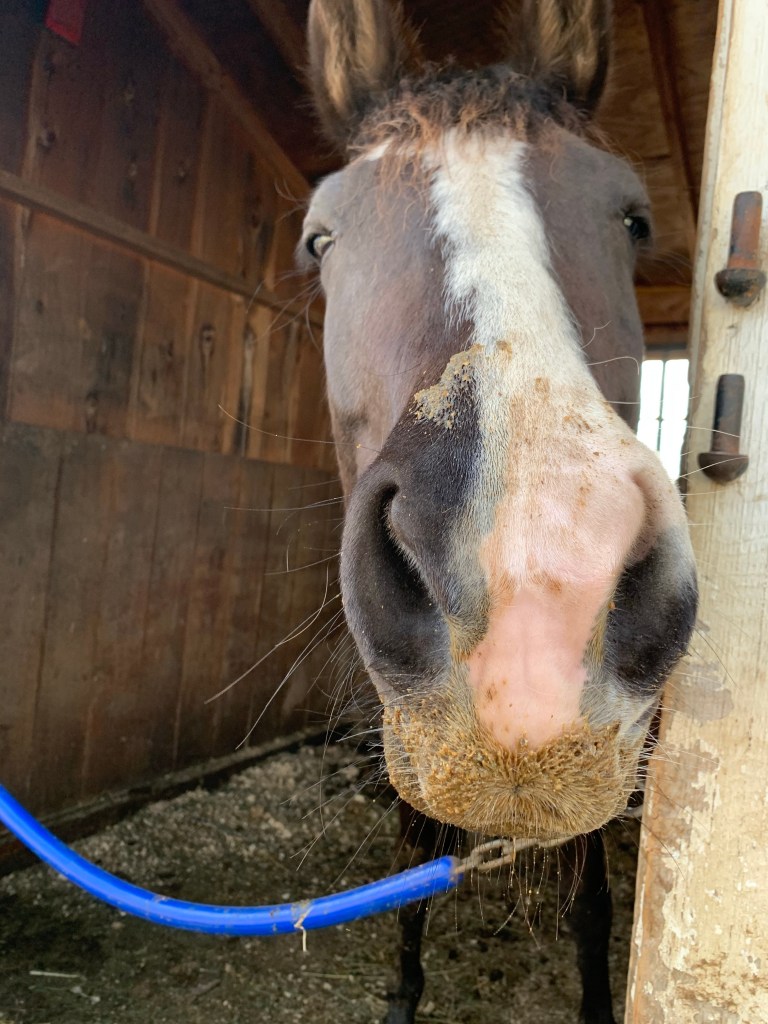
Have you ever taken the time to listen to your horse? Or any horse for that matter? I’m not talking about just sitting in the field, watching the herd of lesson horses mingle and interact.
I’m talking about clearing your mind and only focusing on the horse in front of you. Trying to connect to the innermost thoughts of the horse. Listening to their breathing, watching their body.
Noticing every swish of their tail or twitch of their skin. A change in balance, the movement of one foot versus another. Watching their eyes and ears for subtle signals that something is great or something is wrong.
Tuning into this ability isn’t easy. It takes years of trial and error. Lots of errors. Horses have a way of communicating with each other that is practically invisible to us lowly humans, unless you are actively trying to see and hear it.
The errors come from misunderstanding what the horse is trying to say. Depending how you were trained, or what you learned from watching your trainers and instructors, you could have a different understanding of what certain signals mean in a horse.
For example, some people might believe that a tail swish when you go to tighten the girth means the horse is simply grumpy and doesn’t want to be worked.
Other equestrians might look a little deeper and realize that the horse has tight muscles in its abdomen and back and needs help relieving that tension. That person might hire a massage therapist to relieve that pain and give them a few days off.
However, another human might go even deeper and recognizes that the reason the horse has this tension is tight muscles due to an underlying reason. This could be poor saddle fit and compensating posture to alleviate the pressure on the back from the ill-fitting saddle, or it could be the way the girth is being tightened quickly, rather than incrementally. So this human hires a saddle fitter to address the saddle fit, and then hires a massage therapist to help alleviate the tension that is currently there. They also instruct anyone using that horse to only tighten the girth slowly. One hole at a time. (and hopefully they instruct the whole barn population to do this for every horse).
Out of those three examples, each human noticed that the horse was trying to communicate. The difference is the level of awareness each human had, and the ability or desire to find the root cause of the problem.
In the first example, the human assumes the horse is just touchy and continues on without uncovering any cause or reason behind the behavior. This example could characterize all types of horsemen and women, in any stage of their journey with horses.
We don’t know what we don’t know.
In the second example, the human recognizes that the horse is tense and deserves a massage. This is a great step in alleviating the soreness and symptomes, however without finding out the why behind the soreness, this horse and rider are bound to run into the issue again and again.
This is an example of a rider taking the next step to identify an issue and address it. Listening beyond simple “bad behavior” and identifying a way to help the horse.
The last example shows the human taking a deep dive into why the horse is uncomfortable. By refusing to stop at simply addressing the symptoms of a problem, this human was able to listen to the horse at a deeper level, address the cause of the pain, alleviate the symptoms and most likely go on to have a wonderful relationship with their horse.
Horses don’t want to work. They are born into this world with only two objectives; stay alive and procreate. So the bulk of their daily lives include eating and saving energy in case they need to outrun a predator. If horses overwork themselves they run out of energy stores which makes them less able to out run those rabid dogs in the neighborhood.
I know what you are thinking. “My horse is domesticated and very safe! He doesn’t have to try and stay alive. He has no predators to outrun in his cozy box stall”. This is true. But tell that to his genetic makeup. We all know horses are flight animals. They are prey. They have evolved to have explosive power, which aids them in outrunning predators and running for longer distances than them. They have evolved to snooze standing up so that if there is danger they don’t have to climb back up onto their legs to get away. We have all seen how graceful horses are when they are getting back up from rolling or taking a nap. They waste a lot of time.
Horses want to eat most of the day, then sleep or snooze the rest of it. Intertwine some play and mutual grooming to keep up with the social hierarchy that keeps them alive, and you’ve got a full day of horsey fun.
Enter humans, with their grand plans to compete at international levels or win blue ribbons, or basically do anything other than the above.
The beauty and magic of a horse is that they genuinely want a relationship with you. They are social creatures and enjoy learning. There are plenty of horses that enjoy their work with their human(s). There are also plenty that could have enjoyed their jobs, but felt unheard and misunderstood. These are the horses that begin to develop “behavior” problems.
The duty of any equestrian is to listen to their horse. To put the horse’s feelings, emotions and needs first. The horse must be the priority. They rely solely on humans for their well being. Horses give us so much in return for so little.
The good news is that horses are mostly very forgiving creatures. They are willing to try again. To trust again. Even if you rescue a neglected horse who obviously has had some horrific trauma, that horse will want to trust you. What makes or breaks that desire to trust is whether or not you listen.
 Maple Row Stables